
Impact study and medico-eco benefits of the echOpen O1 probe on bladder globe detection in EHPAD.
Summary of the study
- Background: In the absence of bladder scans, the study evaluated the use of the echOpen probe by nurses in nursing homes to detect or rule out bladder distension.
- Methodology: Five nurses were trained in one hour and then used the probe independently, with the examinations being reviewed by a physician.
- Conclusion: Three urinary catheterizations and one emergency room visit avoided, several examinations performed in less than two minutes, confirming the effectiveness, speed, and ease of use of the catheter in geriatric practice.
1. Background and objective of the study
This study was conducted at the Arpavie De La Tour nursing home by Dr. Ducassy to address the lack of bladder scans. The primary objective was to evaluate the ability of the ultraportable echOpen O1 probe to help nurses detect or rule out a bladder distension, and to measure its impact on the quality of care.
The study also explored additional uses of the probe by physicians already trained in ultrasound, particularly for pulmonary and cardiac ultrasound evaluations.
2. Methodology and protocol
Period and personnel involved:
- Initial period from Monday, April 7 to Friday, April 19, 2025, with an extension until May 2.
- Trained staff: 5 nurses (IDEC and IDE).
- Medical supervision: provided throughout the experiment by Dr. Clémentine Ducassy.
Initial training
A one-hour training session was held on April 7. It covered:
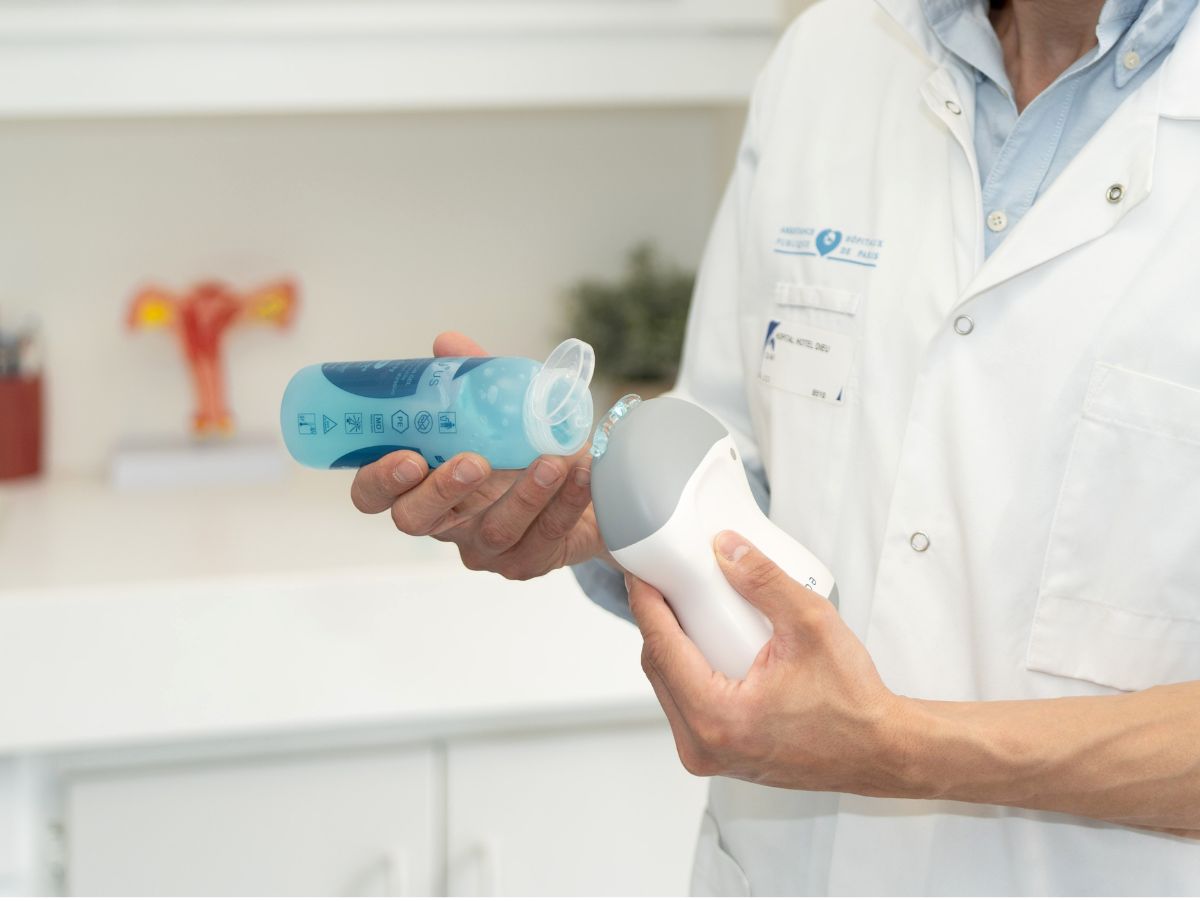
- Handling the probe.
- Connecting to the echOpen application.
- Performing a transverse and sagittal suprapubic scan to locate the bladder.
- Identification of a bladder globe.
- Use the image capture or video loop feature to send to your doctor for confirmation.
It was only after the tests carried out at the end of the session that the nurses demonstrated their ability to independently diagnose the presence or absence of a full bladder.
3. Phases of nursing experimentation.
Five patients were included in this trial to evaluate the use of the probe in real-world conditions.
3.1. Post-training coaching phase (between peers)
Following the training session, the nurses carried out a practical hands-on phase with volunteers from among the participants themselves. These tests on full and empty bladders allowed them to practice handling the probe and interpreting ultrasound images in a safe environment, without any clinical implications.
3.2. Phase of use in real-life conditions (nursing autonomy in nursing homes)
The echOpen probe was then used independently by nurses in their daily practice over several days in nursing homes. After each use, a doctor reviewed the examinations to assess the quality of the observations and validate the diagnoses.
Use cases included:
- Detection or exclusion of a bladder globe, in the presence of discomfort during urination or pelvic pain.
- Checking bladder filling before a urine culture.
- Additional exercises on full and empty bladders, always between team members, to reinforce movement control.
3.3. Medical exploratory phase (dyspnea and cardiac ultrasound)
The team doctor also used the probe in a clinical case of dyspnea. The aim was to test the feasibility of cardiac ultrasound in a real-life situation, under the supervision of a cardiologist.
This phase allowed us to observe:
- A usable cardiac window with visualization of the heart.
- Signs consistent with pulmonary overload (presence of B lines, absence of pleural effusion).
4. Overall results and observations
Diagnostic utility
- Globe detection:
- 3 urinary catheterizations avoided following globe exclusion.
- 1 trip to the emergency room avoided.
- Avoidance of blind catheterization prior to urine culture.
- Pulmonary overload was identified (B lines, no effusion), allowing cardiac treatment to be adjusted under supervision.
Handling by caregivers
- The five trained nurses used the probe completely independently at the end of the training, after a phase of practical testing with the doctor.
- Tests on full and empty bladders were consistently successful.
- Several examinations were performed in less than 2 minutes.
Exploratory use cases
- Cardiac: assessment of LV function, investigation for pericardial effusion, and analysis of IVC (collapsibility) supervised by a cardiologist. Results deemed conclusive.
- Pulmonary: rapid examination revealing B lines without effusion (overload), avoiding unnecessary hospitalization.
5. Assumptions and economic modeling
The study conducted at the Arpavie De La Tour nursing home observed, over a two-week period, three urinary catheterizations avoided thanks to the use of an echOpen ultrasound catheter by a team of trained nurses, as well asone trip to the emergency room avoided. Based on this data, we modeled the potential medical and economic impact on a typical facility. To do this, we used the average characteristics of a 100-bed nursing home with approximately six nurses on duty during the day.
Two scenarios were considered:
- Low (conservative) scenario: we consider that the results observed in the study correspond to the maximum benefits achievable for a given establishment. We then project the observed benefits over one year, without extending them to the entire staff. This represents 78 surveys avoided per year (3 surveys × 26 two-week periods) and 26 transports avoided per year. This scenario corresponds to the minimum expected impact, i.e., approximately 22 hours of nursing time freed up (valued at $440) and $7,800 in savings for the Health Insurance system.
- High scenario (full deployment): if we assume that each nurse equipped with the device achieves the same efficiency as observed during the study, we can estimate 1.5 catheterizations avoided and 0.5 transports avoided per week per nurse. On a scale of 6 nurses over 52 weeks, this represents 468 catheterizations avoided/year and 156 transports avoided/year. This scenario leads to approximately 132.6 hours of nursing time freed up (valued at $2,652) and $46,800 in savings for the community.
Thus, depending on the level of deployment and adoption of the probe within the healthcare team, the economic benefits for an institution range from €8,000 to nearly €50,000 per year, combining internal gains (caregiver time) and gains for the ecosystem (reduction in transport and emergency room visits).
6. Conclusion
The echOpen probe has proven to be an effective, easy-to-use, and immediately operational clinical tool for guiding examinations in nursing practice in nursing homes.
It has enabled:
- Avoid unnecessary invasive procedures (catheterization).
- To reduce the need for emergency or radiology services, for a trained physician, and to adapt treatments in real time.
- To strengthen the autonomy of caregivers in immediate clinical assessment.
This field study, although preliminary and non-randomized, confirms the relevance of ultra-portable ultrasound in nursing care and suggests a tangible improvement in the patient journey in healthcare facilities.
In particular, it demonstrated that the echOpen probe allows bladder detection that is as reliable as a bladder scan, without increasing the error rate, when used by nurses trained through a short and accessible program.
It also offers a decisive advantage: beyond this specific indication, its cardiopulmonary capabilities open up valuable clinical applications in geriatrics, particularly for identifying signs of pulmonary overload or cardiac monitoring, subject to appropriate training.
Impact study and medical-economic benefits – Arpavie De La Tour nursing home – Dr. Ducassy – April–May 2025 | echOpen