Buying a portable ultrasound machine: how to compare probes, prices, and services? The complete guide for 2026
How should you compare portable ultrasound machines before buying one?
Comparing portable ultrasound machines isn't just about looking at the purchase price. You need to check whether it meets your actual needs, is easy to use, is compatible with the devices you use, and comes with long-term support. Services, training, updates, and maintenance are just as important as the probe itself.
Looking for a portable ultrasound machine? Understanding its price, features, and services is crucial to making a good purchase.
Clinical ultrasound has become an essential diagnostic tool in the medical field. There are a number of reasons why a clinical ultrasound probe makes sense for a physician.
First of all, ultrasound is a safe, non-invasive technique, making it a first-rate diagnostic tool for many pathologies. It enables real-time visualization of the body's internal structures, facilitating rapid and accurate diagnosis. What's more, ultrasound is versatile and can be used in a wide range of medical specialties, from emergency medicine to pulmonology and general medicine. Last but not least, having your own ultrasound probe enables doctors to carry out examinations directly at the patient's bedside, improving patient care and follow-up. Investing in an ultrasound probe is therefore an effective way of improving the quality of care and responding to clinical needs more accurately and rapidly.
In this article, we'll explore the different types of probe in terms of price, functionality and associated services. The fundamental criteria for evaluating a probe before purchase are ease of use, scope of functionality and level of training required.
The 4 Key Factors to Consider When Choosing a Portable Ultrasound Machine
1. Ease of use: a fundamental criterion
When choosing an ultrasound probe, ease of use should be your top priority. If you're a clinician who needs fast tools for emergency consultations or immediate assessments, a complex interface can be a hindrance. Here's why:
- Intuitive interface: It's essential that the device is easy to use, with clear menus and quick set-up. An ultra-portable probe should be able to capture images in seconds, without having to go through complicated settings.
- Dedicated mobile applications: Many modern devices work with a mobile app, allowing you to use familiar tools like your smartphone or tablet. Make sure the app is easy to understand and free of unnecessary clutter.
- Minimal training: Unlike more expensive and complex devices, which often require weeks or even months of in-depth training, the simplest portable probes are designed to be used after just a few hours of familiarization. This enables doctors to integrate them more quickly into their daily practice, without slowing down the flow of consultations.
2. Features tailored to your clinical needs
Top-of-the-range ultrasound equipment, often very expensive, offers extremely advanced functionalities (multi-frequency, Doppler, 3D, etc.), but not all practitioners need this arsenal for their daily practice.
- Essential features: Depending on your specialty (general medicine, emergency, gynecology, cardiology, etc.), you may only need basic resolution or a few imaging modes such as B-mode. Choosing a probe with the right features for your clinical needs is essential to avoid overpaying for a device whose capabilities you'll only be able to exploit to the full.
- Versatility without complexity: Some probes offer versatility (abdominal, pulmonary, vascular examination) without being difficult to use. It's important to find the right balance.
3. Portability and connectivity
One of the great advantages of ultra-portable probes is their ability to accompany the doctor wherever he or she may be: whether in a hospital, an office or even on a home visit.
- Size and weight: look for a model that is compact and lightweight enough to be carried easily in a pocket or medical bag.
- Connectivity: Modern probes are often connected via Wi-Fi or Bluetooth to a mobile device. Make sure your probe is compatible with your existing devices (iOS or Android), and that data transmission (images, videos) takes place without significant latency.
4. Durability and maintenance costs
Another aspect often overlooked when purchasing is durability and long-term cost.
- Robustness: Portable probes are often exposed to harsh environments (hospitals, outdoors), so it's important to choose a model that's drop- and shock-resistant, and easy to disinfect.
- Updates and support: Choose a brand that offers regular software updates and responsive customer service. These are essential to ensure the longevity of your device.
What is the total cost of a portable ultrasound machine over 5 years?
There are three product categories on the French market today:
- High-end probes with a wide range of features, services and training requirements demand ;
- Probes dedicated to clinical ultrasound, with a more restricted scope of use, but with a price and training level that enable all healthcare professionals to equip themselves.
- High-end probes
In this product category, we find the sector's long-established manufacturers, including GE HealthCare and its Vscan Air probes, Philips and its Lumify probes, and Mindray with its TE Air. Clarius and Butterfly have also entered this segment. Butterfly has chosen a high-end positioning for its IQ3 probe, which contrasts with its previous IQ+ version.
Functionality level: These ultrasound probes cover a very broad spectrum of uses, including functionalities such as transcranial Doppler and advanced cardiac functions. Their uses go far beyond clinical ultrasound, and they can be used to replace a trolley-mounted ultrasound scanner.
Training Level: The basics of clinical ultrasound require only a limited amount of training. For certain devices with advanced features, physicians may supplement their training with a university diploma (DU) or interuniversity diploma (DIU) in ultrasound in order to fully utilize the devices’ potential.
Price range: Here are the listed prices (including tax) for purchasing the various transducers. These prices include a 5-year subscription, which corresponds to the estimated lifespan of ultra-portable transducers.
- GE HealthCare Vscan Air
- Probe: €5400 incl. VAT
- Optional subscription to individual digital tools (MyRemoteShare + MyImageCloud): €2550 incl. VAT
- Total over 5 years without subscription: €5400 incl. VAT
- Total over 5 years with subscription: €7950 incl. VAT
- Philips Lumify
- Probe: €9590 incl. VAT
- Subscription : No subscription
- Total over 5 years: €9590 inc.
- Mindray TE Air
- Probe: €5038 incl. VAT
- Subscription : No subscription
- Total over 5 years: €5038 inc.
- Butterfly IQ3
- Probe: 4,436€ (including tax)
- Subscription: €2400 incl. VAT
- Total over 5 years: €6836 inc.
- Clarius PAL HD3
- Probe: €5,395 incl. VAT
- Subscription: €2,975 incl. VAT
- Total over 5 years: €8370 inc.
- Affordable probes dedicated to clinical ultrasound
There are two types of ultra-portable probes in this product category.
- Probes manufactured as private-label products by manufacturers—mostly Chinese—and resold by local distributors;
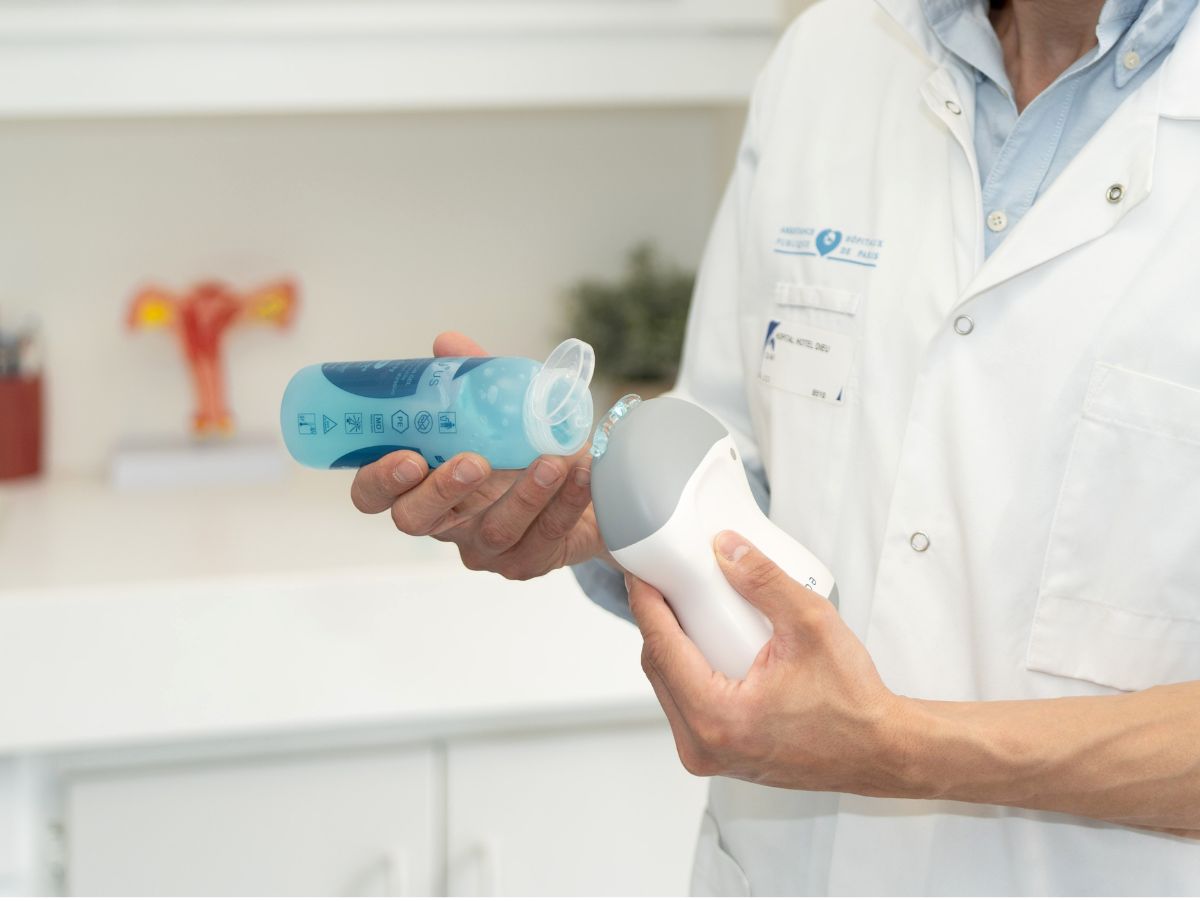
- echOpen the only probe made in France and supported by the APHP that meets most clinical ultrasound needs.
Level of functionality: Affordable probes focus on use in clinical ultrasound, i.e. binary responses to detect the patient's level of severity and which organ is affected. Clinical ultrasound very rarely requires the use of Doppler, which is why the majority of these probes do not integrate this functionality, which is superfluous for so-called clearance ultrasound. It is nevertheless important to select a device that covers the main reasons for consultation, i.e. thoracic, abdominal and pelvic pain.
Level of training required: The level of training in clinical ultrasound is minimal. Most doctors can be trained in just a few days. By reproducing reference sections and then gradually integrating them into practice, doctors can ensure rapid use and mastery of their diagnoses. Bladder globe detection and thoracic ultrasound are examples of the first applications requiring a low level of training.
Price range
- White-label probes (average) :
- Probe: €2800 incl. VAT
- Subscription : No digital service or updates
- Total over 5 years: €2800 inc.
- echOpen Ultrasound Scanner :
- Sensor: €1,460 (including tax), all-inclusive for the first year
- Subscription: €290/year (including tax) starting in the second year
- Lifetime all-inclusive plan, no subscription required: €2,330 (including tax)
What to Keep in Mind Before Buying
The first step in choosing the right ultrasound scanner is to identify its intended use. If your aim is to complement your clinical examination in the same way as your ECG or oximeter, then an affordable probe will be an excellent choice for your first probe. If, on the other hand, you need highly advanced functionalities (such as pulsed Doppler or advanced cardiac functions), then a top-of-the-range device will be more appropriate. Your level of training should also be taken into account, as the more complex a probe is, the higher your level of training needs to be. echOpen today has a unique proposition to satisfy doctors taking their first steps in clinical ultrasound.