.jpg)

Clinical Ultrasound: Why It Is Becoming Indispensable in General Practice
A particularly significant development in general practice
General practice is where initial uncertainty arises. Patients rarely arrive with a clear diagnosis. They come in with a complaint, discomfort, concern, pain, shortness of breath, a fever, or a nonspecific symptom.
The general practitioner’s role is then to turn this complaint into a medical decision: should we wait? See the patient again? Order a test? Refer the patient to a specialist? Send the patient to the emergency room? Monitor the patient’s progress?
In this context, clinical ultrasound can provide useful information, especially when it is targeted. Its purpose is not to increase the number of tests or to complicate the consultation. Rather, its purpose is to provide, in certain situations, visual data that helps inform better decision-making.
This is also why general practice is directly affected. General practitioners do not need comprehensive imaging to get started. They need a tool that helps them answer a few common, practical, and clinically useful questions.
For more information on the use ofultrasound in primary care, echOpen the key benefits ofclinical ultrasound in general practice, with a focus on patient guidance, ruling out conditions, and providing care as close to the patient as possible.
Clinical ultrasound does not alter the nature of general practice. On the contrary, it reinforces what makes it valuable: a patient-centered, community-based primary care practice capable of providing accurate referrals.
Accessibility changes everything
The reason clinical ultrasound has become such a strategic issue today is not simply because ultrasound exists. It has been around for a long time. What has changed is its accessibility.
Ultrasound machines are becoming more compact. Probes are becoming more portable. Images can now be obtained closer to the patient in settings where they were previously difficult to access: private practices, home visits, hospital wards, medical-social facilities, emergency care, and remote locations.
This development is changing the way we use the device. The ultrasound machine is no longer just a piece of equipment installed in a dedicated room. It can become a clinical observation tool, available at the time of the examination.
But accessibility alone is not enough. For clinical ultrasound to be truly useful, three conditions must be met: a tool suited to the field, progressive training, and regular practice.
A tool that is too complex tends to be underutilized. An image without proper training can be misinterpreted. Training without practical application does not translate into real-world practice. It is the combination of these three elements that makes adoption feasible. This is precisely the value of a portable ultrasound device designed for clinical examination: making images available exactly when the physician needs them, without moving the patient away from the point of care.
echOpen Making Clinical Ultrasound More Accessible in Everyday Practice
This is the context in which echOpen fits echOpen making clinical ultrasound more accessible to healthcare providers, right at the patient’s bedside.
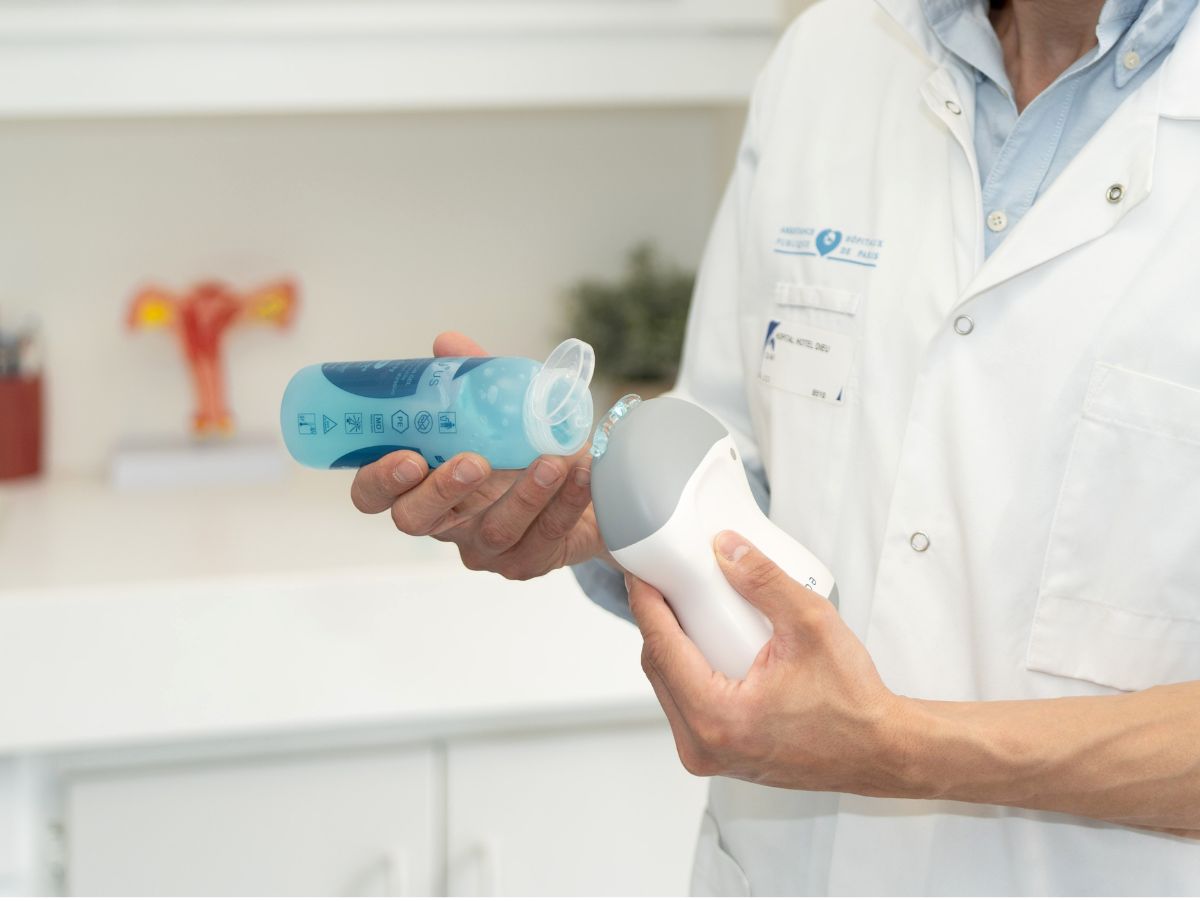
The echOpen probe echOpen designed to support a mobile, simple, and progressive approach to clinical ultrasound. Its ultra-portable design, smartphone connectivity, and versatility address a practical need: enabling clinicians to examine multiple anatomical areas without relying on heavy or cumbersome equipment.
The goal is not to replace specialized imaging. It is to help clinicians incorporate imaging into their daily decision-making for specific applications: heart, lungs, abdomen, kidneys, bladder, blood vessels, FAST, and E-FAST.
This perspective is important. Clinical ultrasound is not becoming more widely accessible simply because of a single device. It is becoming more widely accessible thanks to a comprehensive package: an affordable probe, training materials, supervised practice, and a clear understanding of its limitations.
For physicians who want to move from interest to practice, echOpen an approach designed to help them discover the echOpen probe echOpen its clinical applications, with a simple goal: to make imaging more accessible without compromising the medical examination.
This is how imaging can become a natural extension of the clinical examination: not a dramatic procedure, but simply another tool to help us see more clearly, understand better, and provide more effective guidance.
Conclusion: Seeing is becoming a clinical skill
Clinical ultrasound is becoming indispensable because it adds a new capability to the medical examination: the ability to see at the very moment a decision is made.
It does not replace listening, palpation, auscultation, or clinical reasoning. Rather, it complements them. It provides the physician with additional visual information that is directly related to the patient’s condition.
For general practice, this development is particularly significant. The general practitioner is at the heart of primary care. They must make decisions in the face of uncertainty, provide accurate referrals, and support patients over the long term. Clinical ultrasound can help them fulfill this role more effectively, provided it is used with proper training, caution, and a systematic approach.
The future of the clinical examination will not be any less clinical simply because it incorporates imaging. On the contrary, it may actually be more comprehensive: listening, palpating, auscultating, reasoning, and now observing.
Are you interested in incorporating clinical ultrasound into your practice?
The echOpen probe echOpen designed to make ultrasound more accessible to healthcare providers: it is ultra-portable, connects to a smartphone, and is designed for targeted clinical use, right at the patient’s bedside.
Find out how echOpen support you as you begin using it for consultations.