.png)

Clinical ultrasound as an extension of the physical examination
What if doctors could supplement their clinical examination with an image, right during the consultation?
This is the very essence of clinical ultrasound: to provide the clinician with immediate, targeted visual information, interpreted within the context of the patient’s condition. It does not replace the collection of the medical history, inspection, palpation, percussion, or auscultation. Rather, it complements them.
Physical examinations have always relied on a doctor’s ability to observe, listen, feel, compare, and reason. Clinical ultrasound adds an extra dimension: the ability to see certain structures, movements, or signs at the very moment the question arises.
This approach is gradually transforming the way we examine patients. Not by pitting clinical practice against imaging, but by bringing them together. The physician does not abandon his clinical reasoning; rather, he enriches it with an additional perspective.
A natural evolution of the clinical examination
The history of medicine is also the history of the tools that have enhanced clinicians’ observational abilities. The stethoscope made it possible to listen. The otoscope, ophthalmoscope, and blood pressure monitor have each provided information that is readily available in the clinic.
Clinical ultrasound is part of this ongoing process. It makes visible aspects of the body that, until now, had to be inferred from indirect signs or examined later using specialized imaging techniques.
This development is particularly noteworthy in general practice. The general practitioner is often the first doctor patients see. They must guide patients, prioritize care, reassure them, monitor their condition, and refer them as needed. In this context, having a tool for immediate observation can greatly enhance the clinical examination.
The goal is not to turn every consultation into a full imaging workup. The goal is simpler and more powerful: to answer a specific clinical question at the right time using a tool available at the point of care.
See to understand better
Clinical ultrasound is transforming the patient-physician interaction because it brings together three elements that were often separate: the patient, the physician’s reasoning, and the image.
When faced with pain, shortness of breath, suspected bladder obstruction, or a simple abdominal issue, a doctor may sometimes supplement their physical examination with an immediate imaging study. This image does not replace the doctor’s judgment; rather, it provides additional insight.
This is where clinical ultrasound truly shines: it helps to confirm a clinical impression, refine a hypothesis, and better guide the next steps in patient care. It can also strengthen communication with the patient. By showing, explaining, and putting things into context, the image becomes a tool for shared understanding.
During a consultation, this aspect is invaluable. The patient gains a better understanding of what the doctor is looking for. The doctor can better explain why they are monitoring, addressing, supplementing, or reassuring the patient. Clinical ultrasound thus becomes a tool not only for patient care but also for education.
A tool to support clinical reasoning
Clinical ultrasound is all the more useful because it remains focused. It is not about “looking at everything.” It is about asking a clear question.
For example:
- Is the bladder distended?
- Is there visible pleural effusion?
- Is there evidence of dilation of the renal calyces?
- Is there a better way to identify a structure before performing a procedure?
This approach fits very well with the nature of a medical consultation. The doctor is not seeking a comprehensive examination. Instead, the doctor is looking for information that will help make a decision.
This is what distinguishes clinical ultrasound from specialized ultrasound. Specialized ultrasound remains essential when a comprehensive, standardized, or expert examination is required. Clinical ultrasound, on the other hand, is performed earlier in the care pathway, in direct contact with the patient, to enhance the initial assessment.
It does not, therefore, replace medical imaging. It enables clinicians to make better use of their examinations, to better guide patients, and sometimes to better prioritize additional tests.
A breakthrough particularly well-suited to general practice
General practice is a natural setting for clinical ultrasound. General practitioners encounter a wide variety of situations, often with unclear symptoms, ranging in urgency from mild to severe. They must make decisions quickly, but without rushing. They must reassure patients without downplaying the seriousness of their condition. They must refer patients when necessary, but avoid unnecessary tests when the situation does not warrant them.
In this context, clinical ultrasound can be a valuable tool.
It can help provide a better understanding of a patient’s symptoms. It can offer additional information when the clinical picture is unclear. It can reinforce the appropriateness of a referral. It can also assist in monitoring certain conditions when the physician is trained in its use.
This is precisely why we refer to it as an extension of the physical examination. Clinical ultrasound is not something that takes place “alongside” the consultation. It is integrated into the medical process, as a natural extension of the physician’s reasoning, at the very moment the physician is examining the patient.
For a trained practitioner, it becomes just another clinical procedure: inserting a probe, examining a specific area, and interpreting what is seen in light of what is already known about the patient.
A practice that enhances the clinician's autonomy
One of the major benefits of clinical ultrasound is that it restores the physician’s ability to observe directly.
In many situations, healthcare providers must deal with uncertainty. This uncertainty is an inherent part of medicine. But when a simple tool can help reduce it—even if only partially—it becomes invaluable.
Clinical ultrasound can help clinicians make decisions with greater confidence. It can confirm a hypothesis or, conversely, prompt a reassessment of the situation. It can help better document clinical findings. It can also improve communication with other healthcare professionals when a patient needs to be referred.
This autonomy is not an isolated one. It does not mean that the doctor works alone. It means that the doctor has an additional tool to better fulfill their role in the care pathway: examining, referring, monitoring, explaining, and coordinating.
Training: The Key to Successful Adoption
The enthusiasm surrounding clinical ultrasound must go hand in hand with one essential requirement: training.
A portable ultrasound machine makes the technology accessible, but it is training that makes its use meaningful. You need to learn the different views, recognize normal images, identify specific abnormalities, and also know when the image is insufficient or when specialized imaging is still necessary.
The good news is that this progression can be gradual. There’s no need to learn everything all at once. A doctor can start with a few simple, common, well-defined applications and then gradually expand their practice.
This step-by-step approach is particularly well-suited to general practice. It allows for the integration of clinical ultrasound into the daily routine of the practice without disrupting the entire consultation process.
The goal is not to become a radiologist. The goal is to become a clinician capable of using imaging when it provides a useful answer to a clinical question.
Portable ultrasound machines designed for field use
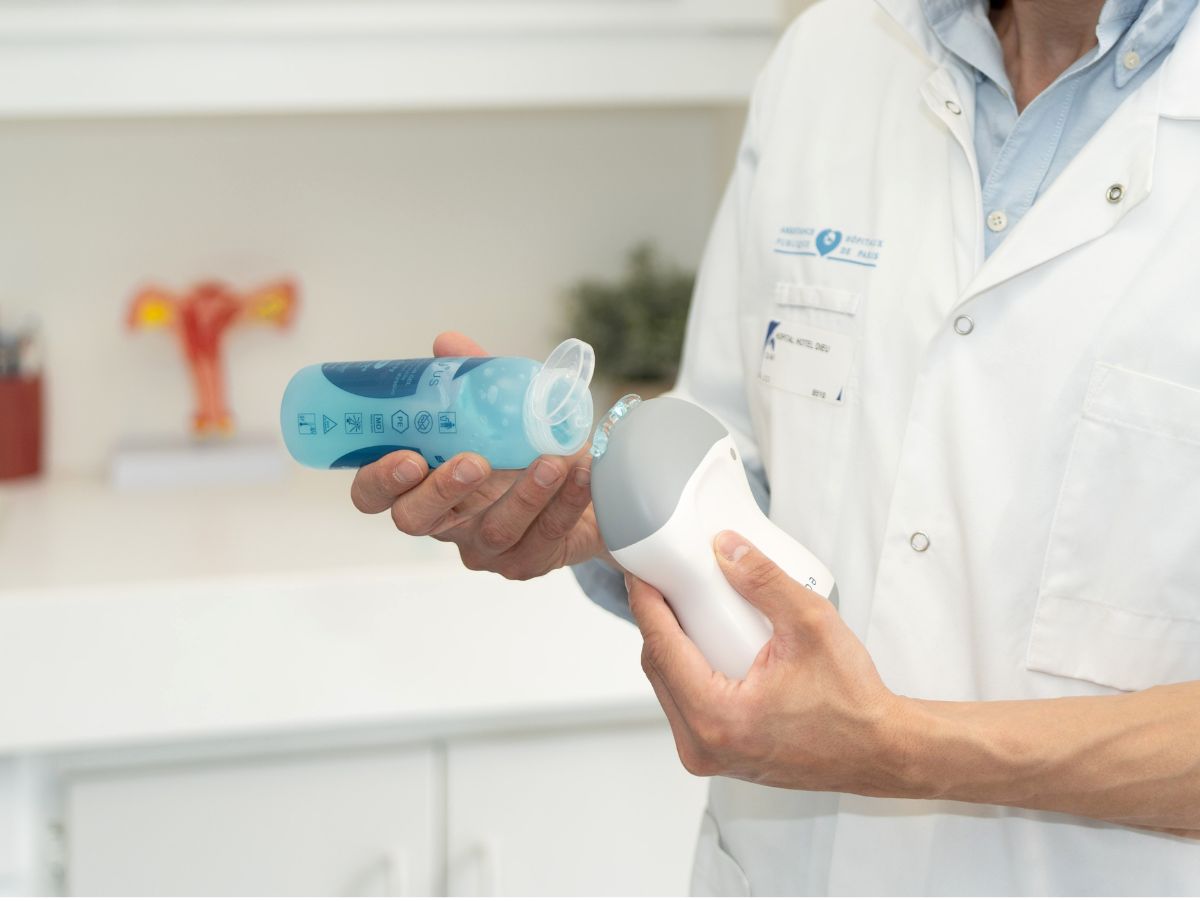
One reason clinical ultrasound is becoming more accessible today is that the equipment has advanced. Portable ultrasound machines make it possible to bring the image as close as possible to the patient: in the doctor’s office, during home visits, in healthcare facilities, in nursing homes, during emergency care, or at the patient’s bedside.
This portability changes a lot. Ultrasound is no longer limited to a dedicated room or a bulky machine. It can now be a tool that fits in a healthcare provider’s pocket, ready to use whenever the clinical situation calls for it.
The echOpen portable ultrasound system was designed with this goal in mind: to make clinical ultrasound more accessible, more portable, and easier to integrate into daily practice. The aim is to enable healthcare providers to enhance their clinical examinations with targeted imaging, without intending to replace specialized imaging.
The equipment becomes even more valuable when paired with a structured learning process. That is why training in clinical ultrasound is a central part of the adoption process: learning step by step, case by case, slice by slice.
A new way of examining, without abandoning clinical practice
Clinical ultrasound does not mark the end of the physical examination. It marks the beginning of a new phase.
The doctor continues to listen, observe, palpate, auscultate, and reason. But when circumstances allow, he or she can also see. This ability changes the relationship to uncertainty, to the patient, and to decision-making.
It enriches the examination. It brings the image closer to the care process. It gives the clinician an additional tool for understanding what is happening, right here and now.
When used properly, clinical ultrasound is not a standalone technical procedure. It is a natural extension of the clinician’s clinical assessment.
FAQ
Does clinical ultrasound replace the physical examination?
No. It complements it. Clinical ultrasound provides targeted visual information, but it must always be interpreted in conjunction with the patient’s medical history, symptoms, physical examination, and clinical context.
How does this differ from a specialized ultrasound?
Clinical ultrasound provides answers to specific questions at the point of care. Specialized ultrasound involves a more comprehensive imaging examination, often following a standardized protocol, with expert interpretation and a detailed report.
Is this suitable for general practice?
Yes, provided that one is properly trained and uses ultrasound in ways appropriate to one’s practice. General practice is particularly well-suited to targeted ultrasound, integrated into clinical reasoning and patient care.
Why do we refer to an extension of the physical examination?
Because clinical ultrasound is an integral part of the examination. After taking a history, observing, palpating, or auscultating the patient, the physician can use imaging to supplement their assessment when a specific clinical question arises.
Conclusion
Clinical ultrasound marks a new milestone in medical examinations. It does not replace the clinical examination; rather, it adds a new dimension to it.
For the general practitioner, it can become a practical, useful, and inspiring tool. A way to observe more closely, understand better, explain more clearly, and provide better guidance. It is also a way to bring the patient’s image into focus at the very moment a decision is being made.
When used properly and with proper training, clinical ultrasound has emerged as one of the most promising extensions of the physical examination. It does not alter the physician’s role; it simply provides a new tool to perform that role with greater precision, confidence, and patient-centered care.