.png)

Pleuropulmonary ultrasound: a clinical reflex for winter
With the arrival of winter and the resurgence of respiratory infections, pulmonary clinical presentations are on the rise.
Acute community-acquired pneumonia, influenza-like syndromes, respiratory failure, exacerbations of chronic conditions...these are all situations where rapid and reliable diagnosis is crucial.
In light of these challenges, recent recommendations from learned societies have establishedpleuropulmonary ultrasound as a first-line tool that is accessible, reproducible, and can be used immediately at the patient's bedside.
A very specific context
The recommendations updated in 2025 by the SPLF, SPILF, and SFMU in favor of pleuropulmonary ultrasound are not the result of chance. They are part of a profound transformation in medical practice, where clinical ultrasound—or point-of-care ultrasound (POCUS)—is gradually establishing itself as an essential tool for diagnostic reasoning.
In recent years, the diagnostic performance of clinical ultrasound has been consistently documented and praised in scientific literature. It provides immediate, non-invasive, and reproducible visualization of anatomical structures and pathological signs, with a level of accuracy that often rivals conventional imaging examinations. This rise in popularity can be explained in particular by the miniaturization of devices, their increasing affordability, and the gradual integration of ultrasound training into medical curricula, both at the university level and in continuing education.
The National Society for Ultrasound in General Medicine (SNECHO-MG) draws attention to the growing number of general practitioners already trained in ultrasound who use this technique regularly and are increasingly equipping themselves with rapid, reliable diagnostic aids that can be used independently. For its part, WONCA Europe, the European federation of family doctors, has highlighted the rise of ultrasound in primary care, not only to confirm or rule out emergencies, but also to refine the diagnosis of low- to medium-complexity conditions such as respiratory infections, abdominal pain, and pleural effusions.
The College of General Medicine, in a note published in 2024, described clinical ultrasound as an "obvious evolution" in primary care medicine. According to its surveys, the majority of trained physicians believe that ultrasound significantly improves diagnostic accuracy, reduces referral times, and strengthens the doctor-patient relationship by making the examination more interactive and explicit.
From a scientific standpoint, the data is solid. Several meta-analyses and systematic reviews —notably those by Orso et al. and Strøm et al. — confirm the excellent performance of pleuropulmonary ultrasound in diagnosing pneumonia, as an alternative to chest X-rays. The figures speak for themselves:
- Average sensitivity: 92%
- Average specificity: 93%
- Durée moyenne d’examen : < 10 minutes
- Proven reliability even among non-radiologist practitioners
These results reinforce the idea that pleuropulmonary ultrasound is no longer a tool reserved for imaging departments or specialists, but rather a cross-disciplinary skill that is accessible to any trained clinician and particularly relevant in winter, when respiratory conditions are widespread.
The update to the recommendations also comes in a post-COVID context, where imaging practices have been thoroughly reevaluated. The eCHOVID study , for example, led by Dr. Mehdi Benchoufi, compared the performance of ultrasound, CT scans, and X-rays in assessing lung damage in patients suspected of having or diagnosed with Covid-19. The results showed that ultrasound was accurate, fast, and suitable for clinical triage, even outside of radiology departments.
Faced with the saturation of imaging services and the need for rapid outpatient diagnosis, pneumopleural ultrasound is emerging as a pragmatic and effective solution.
Ultrasound vs. X-ray: what should you remember?
Pneumopleural ultrasound is distinguished by its speed, portability, and excellent diagnostic performance, with sensitivity and specificity approaching 90%. It allows for immediate assessment at the patient's bedside, without radiation, and fits perfectly into clinical reasoning, particularly in the context of community or emergency medicine.
Unlike X-rays, which require technical equipment and time for interpretation, ultrasound provides an instant answer to a specific clinical question. It is particularly useful in elderly patients, those with reduced independence, or when imaging services are overwhelmed. The recommendations emphasize that pneumopleural ultrasound can be performed by non-radiologist physicians, provided they have undergone appropriate training. It thus becomes an accessible decision-making tool, complementary to radiography, and sometimes even preferable in certain clinical situations.
Far from replacing X-rays, pleuro-pulmonary ultrasound is complementary to them. It offers greater autonomy, responsiveness, and precision, while adapting to the constraints of the field.
Clinical cases and specific indications
Pleuropulmonary ultrasound has a place in many everyday clinical situations. In general medicine as well as in emergency departments, it provides quick answers to simple but crucial questions:
- Suspected community-acquired pneumonia: visualization of alveolar syndrome, monitoring of progress under treatment.
- Acute dyspnea: differentiate between pulmonary edema and infection or pleural effusion.
- Chest pain: identify effusion, interstitial syndrome, or rule out serious pathology.
- Post-COVID or post-flu follow-up: assessing the regression of lung lesions without resorting to heavy imaging.
- Elderly patients or patients with reduced mobility: perform an examination at the patient's bedside, without moving them or exposing them to radiation.
Pleuropulmonary ultrasound as seen by practitioners
Pleuropulmonary ultrasound is no longer reserved for hospital departments. More and more general practitioners, emergency physicians, and pulmonologists are incorporating it into their daily practice. This is the case for Dr. Thibaud Auger, a general practitioner in Auvergne-Rhône-Alpes:
"The diagnosis of pneumonia is a set of arguments. The image is added to the interview and auscultation to point toward a diagnosis, map it out, and help determine its timing. Just yesterday, I used it with a new asthma patient who was experiencing breathing difficulties that he described as unusual. I heard crackles during auscultation, which left me in doubt: was this normal for an asthma patient with blocked secretions, or was it possible pneumonia, which in his case was well tolerated? Thanks to the image, I was able to confirm that there were indeed consolidation, as well as determine the extent of the condition, which in his case was fairly limited. I was therefore able to treat him as a first-line treatment for an asthma attack aggravated by viral pneumonia, as well as giving him antibiotic treatment if there was no improvement. I showed him the ultrasound images, explaining my reasoning and why antibiotic treatment was necessary. The more the patient understands, the more reassured he is, and the more effective his treatment will be. Adding imaging to the clinical examination is also an important asset in facilitating this dialogue."
How can I learn how to perform pleuropulmonary ultrasound?
The practice of pleuropulmonary ultrasound requires prior training, as specified in the recommendations. The good news is that this training is available to all physicians, even those who are not radiologists. Qualifications vary depending on the specialty and the desired level of competence. Additional training is often recommended for practitioners who wish to specialize in specialized ultrasound.
The objective: first acquire the technical skills, then perfect the technique indication by indication. You will begin by analyzing normal scans, then proceed to compare them with pathological scans. Once you feel confident interpreting the images for a given indication, you will learn to integrate ultrasound into your clinical reasoning, in addition to the elements of your physical examination.
Available formats:
- Short in-person or video sessions, such as those offered by CFFE, EchoFirst, A2FM, etc.
- E-learning modules with clinical cases (such as those offered by SantéAcadémie)
- Practical workshops at conferences or in healthcare facilities (such as those offered by Winfocus or CHEM)
- On-the-job mentoring with experienced practitioners
- University degrees, to go further (such as those offered by Paris Cité University)
The clinical ultrasound training courses offered by EchoFirst, Winfocus, CFFE, CHEM, and A2FM provide a variety of programs tailored to the needs of practitioners. A large number of training sessions are organized each year in major cities across France. Some organizations also offer online training. The duration and cost vary depending on the level of specialization and the content of the training, with an average price of €350 for a 1- to 2-day course. This price may be reimbursed by the DPC. These organizations are recognized for their expertise and commitment to providing quality training.
echOpen an ideal solution for getting started
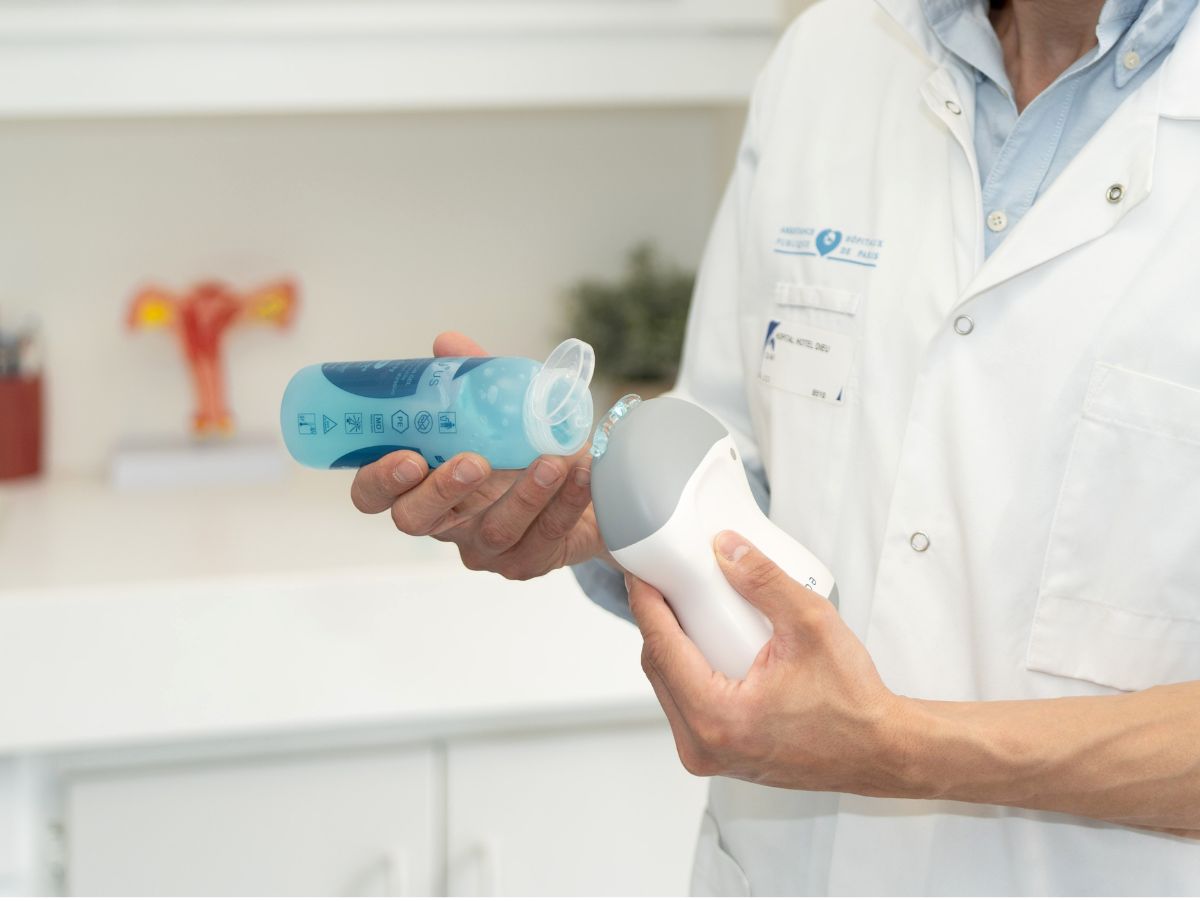
echOpenis a clinical ultrasound device designed for use in the field: portable, accessible, and essential. Its intuitive use and affordable price allow every healthcare professional to equip themselves and train in ultrasound, without compromising on image quality.
This winter, echOpen alongside doctors to make pleuropulmonary ultrasound a shared clinical reflex.