
Ultrasound training in general practice: the importance of practice
The integration of ultrasound into general medicine responds to a twofold contemporary challenge. On the one hand, general practitioners are faced with growing demand for primary care due to an aging population, increasingly complex care pathways, and a rise in chronic conditions. On the other hand, they must cope with increasingly long waiting times for additional tests, which hinder rapid diagnosis and effective treatment.
This context creates a form of dependence on specialists, which is particularly evident in common situations such as abdominal pain, dyspnea, or suspected phlebitis. The lack of immediate imaging tools during consultations leads to frustration, delays in treatment, and sometimes avoidable diagnostic uncertainty.
In this context, mastery of point-of-care ultrasound (POCUS) becomes a decisive lever. Thanks to ultrasound training for general practitioners, clinicians can access simple, targeted imaging tailored to their practice. This skill transforms the clinical examination into a reinforced, dynamic, and potentially decisive act, aligned with the evolution of medical practices in the field.
Why should general practitioners master ultrasound?
Mastering ultrasound provides general practitioners with a fundamental gain in clinical autonomy . By integrating ultrasound into their daily practice, they can refine or confirm a diagnosis immediately, without having to systematically refer a patient to a specialist or wait for an X-ray to be performed. This direct diagnostic capability boosts clinical confidence and optimizes the care pathway.
It also contributes to improved immediate care. With adequate training, general practitioners can reduce diagnostic delays, refer patients more quickly, and respond proactively in situations such as abdominal pain, dyspnea, or suspected deep vein thrombosis (DVT). Ultrasound thus becomes a powerful tool for efficiency and responsiveness in consultation.
Used as a complementary tool to clinical examination, ultrasound does not replace it, but extends it. It acts as an extension of the stethoscope, providing rapid visualization of internal structures in clearly targeted situations, without resorting to heavy or specialized imaging.
This need is accentuated by the current epidemiological and territorial context. Faced with medical deserts and pressure on hospital facilities, general practitioners must have local and pragmatic solutions at their disposal to ensure effective care. Point-of-care ultrasound (POCUS) fits perfectly into this approach.
Finally, this practice is in line with developments in international practices. In several countries, such as Canada and the Nordic countries, POCUS is already integrated into the daily routine of general practitioners. It is recognized as an essential tool in modern medicine, perfectly aligned with current recommendations.
How can general practitioners train in ultrasound?
General practitioners can access initial or continuing training tailored to their needs. Among these, university degree programs (DU/DIU) offer a solid foundation of knowledge, while short certificate programs, offered by private organizations and/or learned societies, provide more targeted and rapid learning, adapted to busy schedules.
There are various teaching formats. Face-to-face learning allows for practical immersion, particularly through workshops using simulators and standardized patients. E-learning, often supplemented by practical modules, facilitates independent and progressive learning. Blended learning combines both approaches to maximize teaching effectiveness.
The typical educational content of these courses covers the physical basics of ultrasound and probe manipulation. It includes learning basic cuts, the FAST protocol, and locating abdominal, pleuropulmonary, and vascular organs, which is relevant in the context of general medicine.
These training courses can be integrated into the Continuing Professional Development (CPD) program, with funding opportunities available through the ANDPC or FIF-PL, making them more affordable.
How can general practitioners improve their ultrasound skills?
The necessity of repetition and regular practice:
Learning ultrasound relies heavily on visual memory and recognition of sonographic patterns. In order for diagnostic reflexes to become reliable, a significant amount of practice is essential. Regular repetition helps to consolidate what has been learned and improve diagnostic accuracy.
Supervision, mentoring, and peer exchanges:
Mentoring and advanced training play an essential role in practitioners' progress. Being supervised by an experienced peer, benefiting from structured mentoring, or participating in sharing groups between trained practitioners facilitates the acquisition of technical subtleties and improves confidence in the use of ultrasound.
Use of digital tools:
Simulators, interactive imaging platforms, and guided self-assessment modules are valuable additions. They allow users to practice in a safe environment, self-correct, and enhance their skills at their own pace, particularly as a complement to clinical activity.
Creation of standardized protocols for office practice:
To integrate ultrasound smoothly into your practice, it is recommended that you limit its use to codified, simple, high-value-added procedures that can be learned quickly. This ensures safe use and consistent diagnostic accuracy.
Feedback from practitioners who have already been trained:
Testimonials from trained general practitioners, case studies, and observed benefits are unanimous: improved patient relations, time savings during consultations, and reduced anxiety in situations of clinical uncertainty. This feedback confirms the relevance of integrating ultrasound into medical practice. Read the feedback from Dr. Thibaud Auger, a general practitioner, on his use of clinical ultrasound in his practice!
Use of ultraportable ultrasound devices
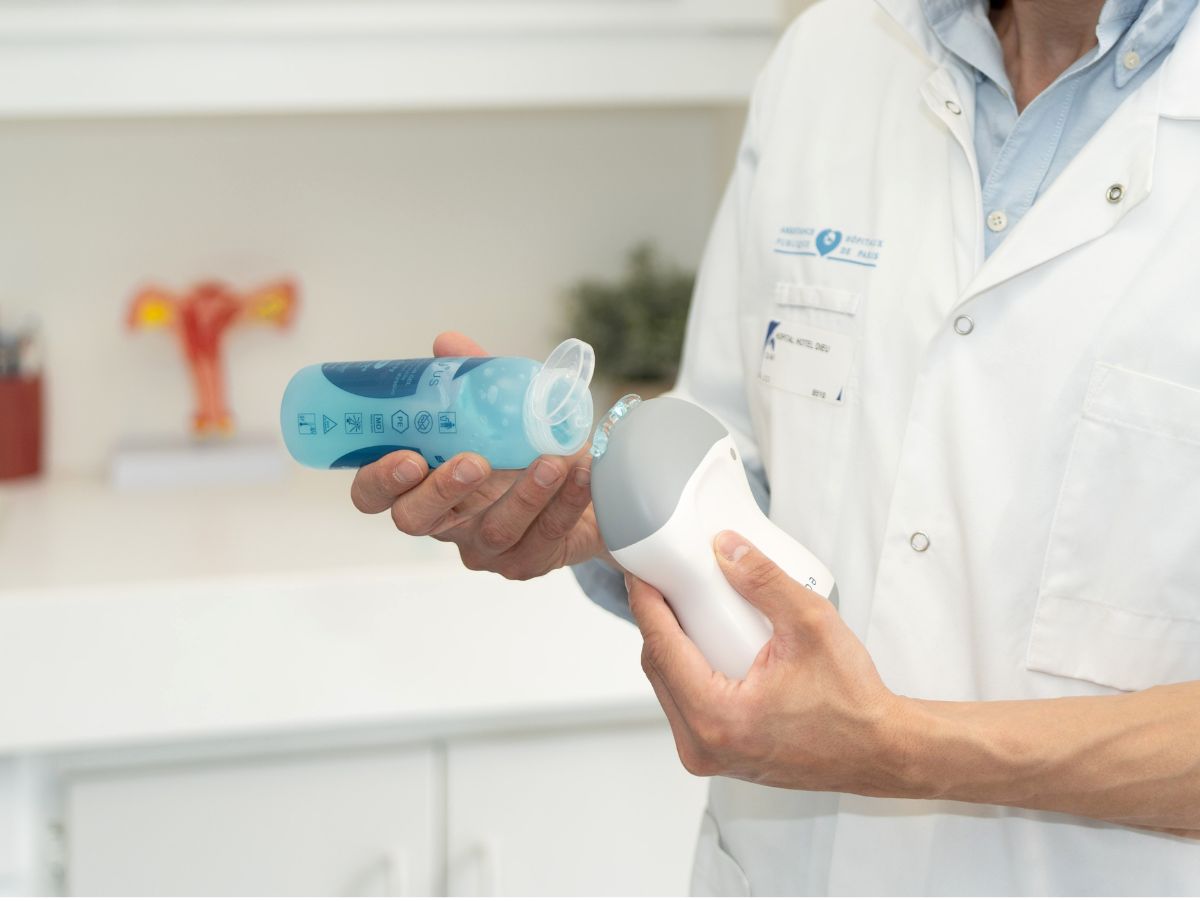
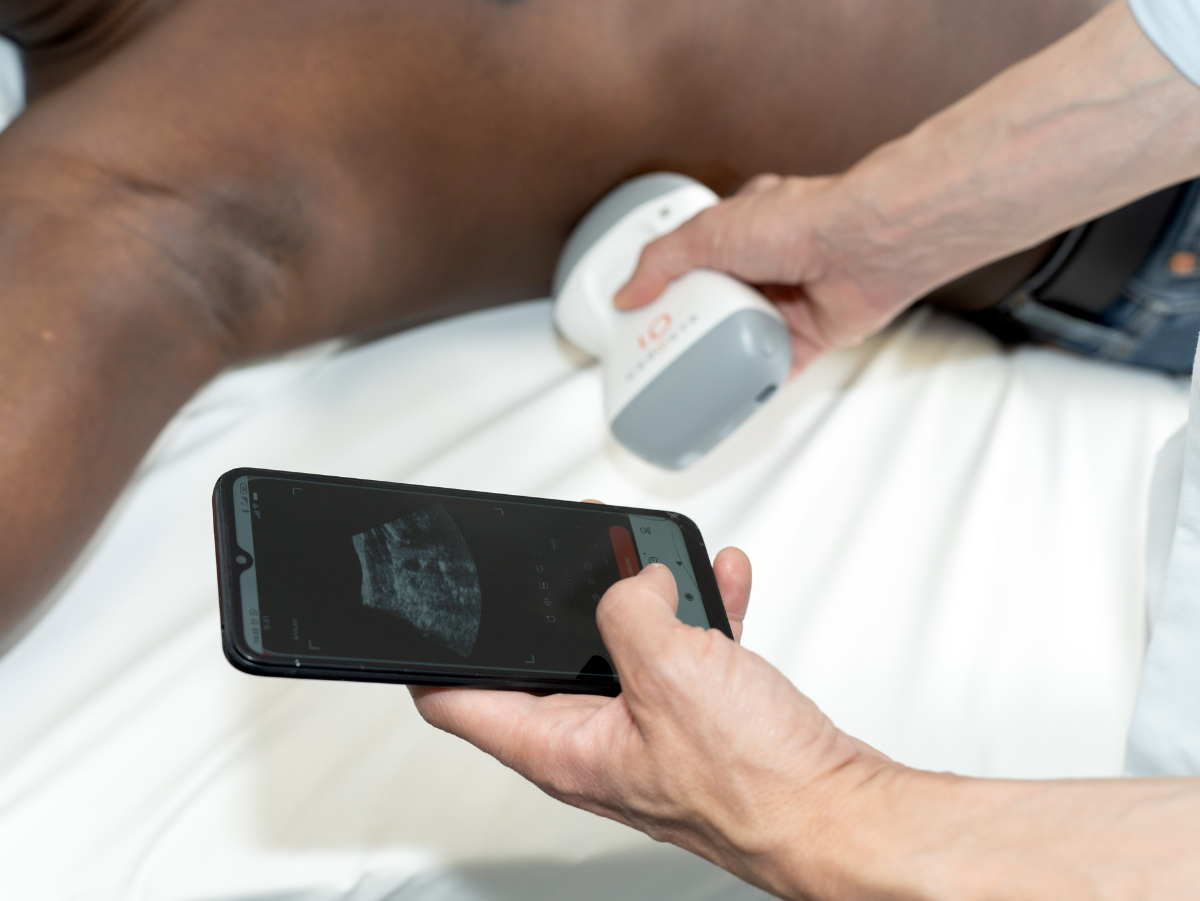
Solutions like the echOpen portable ultrasound probe are a game-changer: extremely portable, with wireless connectivity to a smartphone, a battery life lasting more than a full day of practice, and image quality sufficient for rapid diagnosis. Their pocket-sized design makes it easy to incorporate them into general practitioners’ daily routines, making ultrasound as accessible as a stethoscope.
What are the different conditions detected by general practitioners using ultrasound?
Ultrasound can be used to detect a wide variety of conditions in general practice.
Abdominal conditions are among the most common: acute abdominal pain (renal colic, cholecystitis, suspected appendicitis) or functional digestive disorders (assessment of stasis, bladder distension). It enables effective triage, appropriate referral, and an initial medical decision.
In terms of pleuropulmonary conditions, ultrasound can identify pleural effusions, pneumopathies, and atelectasis, and can be used to monitor chronic respiratory failure (CRF). It is particularly useful in cases of acute dyspnea.
Vascular conditions such as DVT can be identified during consultation by checking the compressibility of the femoral or popliteal veins. This quick assessment immediately guides treatment.
General practitioners can also investigate musculoskeletal conditions such as tendinopathies, joint effusions, cysts, etc. Ultrasound is a valuable aid in assessment and follow-up.
In primary gynecology/obstetrics, ultrasound confirms intrauterine pregnancy, identifies suspected ovarian pathology, or allows for simple pregnancy monitoring.
Finally, certain emergency or semi-emergency procedures can be performed or specified: simplified FAST ultrasound protocol, assessment of vascular filling, detection of pericardial effusion or bladder distension.