.png)

In collaboration with AP-HP and the Pasteur Institute, echOpen successfully echOpen two major clinical trials validating the performance of its ultra-portable echOpen ultrasound device.
echOpen announced today the successful completion of two multicenter clinical trials—CLIN-ECHO-II in France, sponsored by Assistance Publique - Hôpitaux de Paris, and PRESTO in Senegal, in collaboration with the Pasteur Institute—demonstrating the reliability, accuracy, and usability of its echOpen O1 ultra-portable ultrasound device, particularly in the detection of hepatic steatosis and for obstetric applications.
Access to medical imaging remains a major challenge in many clinical settings, particularly in community medicine, in medical deserts, or in emergency departments. Ultrasound, as a non-invasive, rapid, and radiation-free diagnostic tool, is particularly well suited to these contexts. However, conventional devices are often expensive, bulky, and reserved for specialists.
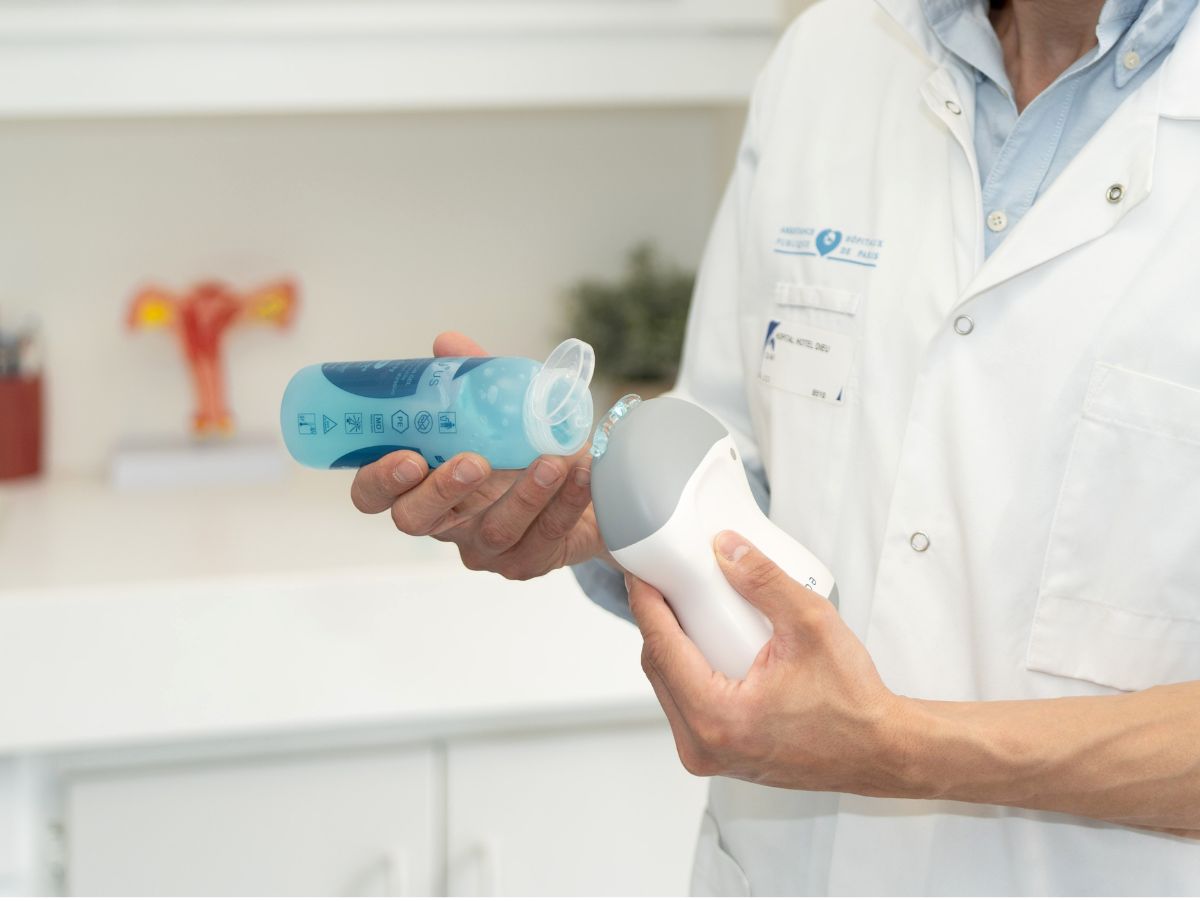
The echOpen device, developed by echOpen, aims to democratize access to ultrasound imaging thanks to an ultra-portable, personal probe that connects to a smartphone, is easy to use, and is low-cost. The two clinical trials conducted in parallel evaluated this device in practical and complementary uses, particularly in pregnancy monitoring and the detection of common abdominal pathologies.
Two studies, one goal: democratizing medical imaging
The CLIN-ECHO-II and PRESTO studies were conducted to evaluate the performance of the echOpen ultra-portable ultrasound device in various clinical settings. CLIN-ECHO-II focused on the detection of abdominal pathologies in hospitals in France, while PRESTO focused on pregnancy monitoring in semi-rural areas in Senegal. Together, they demonstrate the reliability, safety, and adaptability of the device in critical medical applications.
The ultra-portable echOpen ultrasound device was the subject of a multicenter clinical study, promoted byAP-HP, aimed at evaluating its performance in real-world healthcare settings with 200 patients. Named CLIN-ECHO-II, this interventional study was conducted by non-radiologist clinicians in several hospitals, with the primary objective of detecting two common abdominal pathologies: dilation of the pyelocaliceal tract and hepatic steatosis.
Each patient included in the study was examined first with the echOpen device, then with the department's standard ultrasound scanner. In the event of a discrepancy between the two diagnoses, a referring radiologist was called in to establish a reference. This protocol made it possible to evaluate the diagnostic concordance between the two tools, while testing the robustness and safety of the device in a demanding hospital environment.
PRESTO, conducted in partnership withthe Pasteur Institute in Dakar, focused on integrating the echOpen device into third-trimester pregnancy monitoring, starting at 37 weeks of amenorrhea (SA), in primary care settings. The prospective, randomized, multicenter study was conducted at two clinical sites in Senegal (Sokone and Karang), with the participation of 221 pregnant women. Each participant was examined by two trained midwives, who used the echOpen probe and a standard ultrasound scanner in random order. The criteria evaluated included essential obstetric parameters: number of fetuses, fetal presentation, cardiac activity, and placental position.
The results revealed a concordance of 99.5% to 100% between the two devices, with perfect Kappa coefficients for several indicators. The study also demonstrated the operational feasibility of using the device by midwives in the field, without impacting medical care and in compliance with international standards of good clinical practice (ISO 14155:2020).
Accessible, reliable technology adapted to real-world conditions
The echOpen device, designed to be affordable, mobile, and easy to use, is part of an effort to democratize medical imaging. These two studies confirm its ability to provide reliable diagnostic assistance, both in state-of-the-art hospitals and in resource-limited settings.
" These results mark a decisive step forward for echOpen. They scientifically validate what we have been advocating from the outset: that it is possible to make medical imaging accessible, reliable, and universal. Through these studies, we have demonstrated that our echOpen device is just as useful in a state-of-the-art hospital as it is in a rural maternity ward in a developing country, with the same high standards of quality. This proves that technology can be a lever for health equity, provided it is designed for and with healthcare professionals in the field," says Mehdi Benchoufi, co-founderechOpen.
Outlook
Building on the success of these studies, echOpen a new phase of development, with the ambition of deploying its echOpen device on a large scale in a variety of medical environments, both in France and internationally.
Several strategic initiatives are now underway:
- Operational deployment as an individual probe in hospitals, primary care facilities, and nursing homes, in partnership with public institutions and training providers.
- Training and support for healthcare professionals in the use of point-of-care ultrasound (POCUS), particularly through educational modules tailored to local contexts.
- Expansion of clinical use cases, with new studies planned for other common diseases.
- Fair access to medical imaging, working with health agencies, donors, and NGOs to integrate echOpen into public health programs, particularly in Africa and Eastern Europe.
These prospects are in line withechOpen founding missionechOpen to make medical imaging accessible, sustainable, and universal, drawing on technology, open science, and international cooperation.