
5 key uses of clinical ultrasound in hepatology and gastroenterology
Why clinical ultrasound is transforming hepatology and gastroenterology
Hepatology and gastroenterology is a specialty in which clinical practice and imaging are closely linked. The liver, gallbladder, pancreas, intestine, and portal system are deep organs that are often difficult to assess by inspection or palpation alone. Clinical ultrasound, or point-of-care ultrasound (POCUS), provides an immediate response to this challenge. Portable, non-invasive, repeatable, and accessible at the patient's bedside, it allows practitioners to obtain crucial information in a matter of seconds for diagnostic guidance, monitoring progress, or making therapeutic decisions. In a context where hospital flows are strained and outpatient medicine is growing, this ability to "see what you are examining" becomes a major asset.
Literature review: what recent studies show
Medical literature from the last ten years converges on a clear finding: clinical ultrasound improves diagnostic accuracy and speeds up treatment in hepatology and gastroenterology. Several studies show that it detects very small volumes of ascites, sometimes as little as 100 mL, with significantly higher sensitivity than clinical examination. In biliary pathologies, it is particularly effective in identifying acute cholecystitis or gallstones, with reported sensitivities between 82% and 94%. It is also a reliable tool for screening for moderate to severe hepatic steatosis, useful as a first-line test even if it does not replace elastography techniques. In emergency departments, its contribution is decisive: in cases of acute abdominal pain, it reduces the time to diagnosis and allows for faster referral for relevant additional tests. Finally, in cirrhotic patients, it facilitates close monitoring of ascites, portal system permeability, and morphological changes in the liver. The trend is clear: clinical ultrasound is no longer a simple complement, but a natural extension of the physical examination.
5 practical uses of clinical ultrasound in hepatology and gastroenterology
1. Ascites
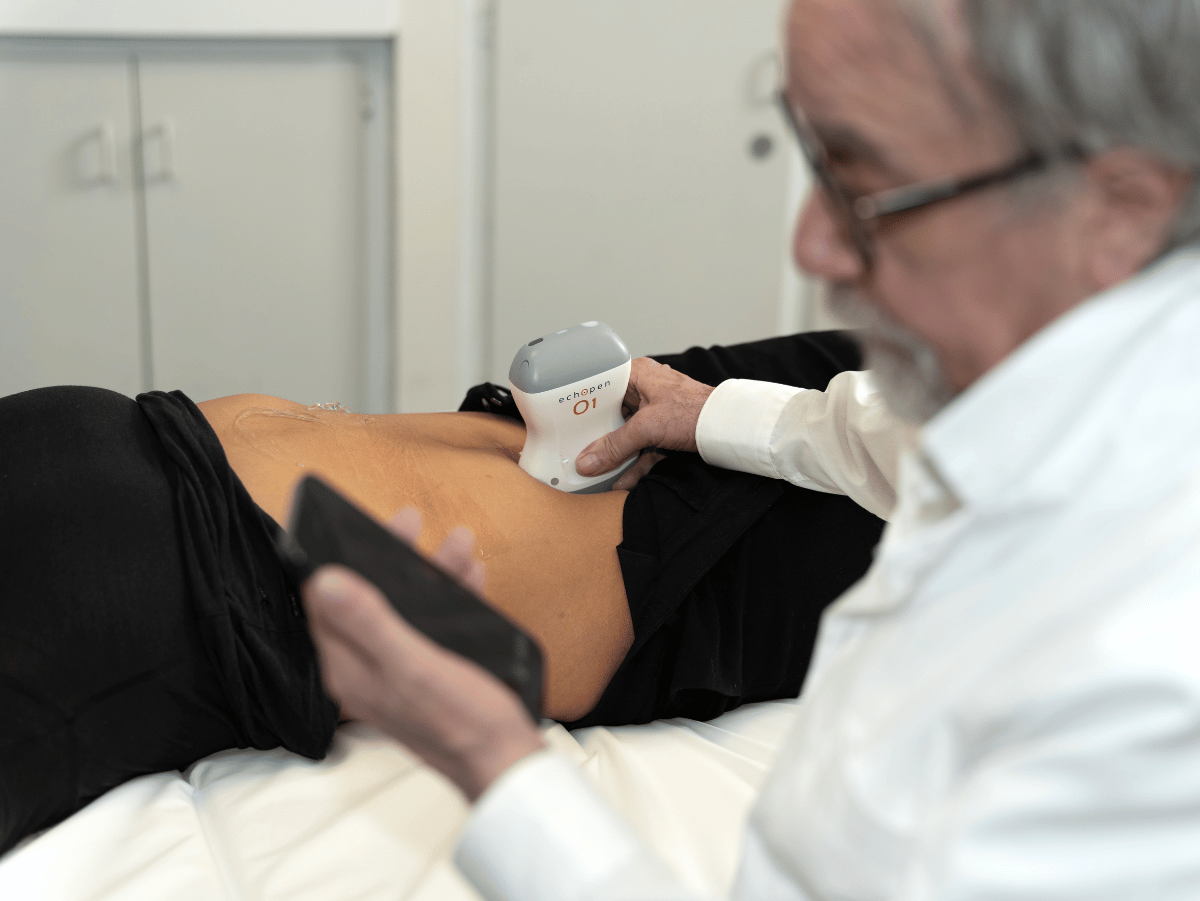
One of the most frequent uses of clinical ultrasound in hepatology and gastroenterology is the detection and semi-quantitative measurement of ascites. In just a few seconds, clinicians can confirm its presence, estimate its volume, and assess the need for paracentesis. This rapid examination also allows for monitoring of progress during diuretic treatment, providing dynamic surveillance that is particularly useful in frail patients or during follow-up consultations.
2. Biliary disorders
Clinical ultrasound also plays a central role in the diagnosis of biliary pathologies. When faced with pain in the right hypochondrium, it can be used to identify gallstones, assess the thickness of the gallbladder wall and the presence of peri-vesicular effusion, or detect dilation of the bile ducts. This ability to quickly distinguish between simple hepatic colic and acute cholecystitis or early cholangitis significantly improves the relevance of therapeutic decisions.
3. Liver evaluation
During consultations, morphological assessment of the liver is another major use. Clinical ultrasound allows the size of the liver to be assessed, signs suggestive of chronic liver disease such as irregular edges or hypertrophy of the left lobe to be identified, and moderate to severe hepatic steatosis to be detected. This initial level of imaging effectively guides patients towards more specialized examinations when necessary.
4. Exploration of the door system
Exploration of the portal system is also an important field of application. In patients with cirrhosis or suspected portal hypertension, clinical ultrasound can be used to visualize the portal vein, assess its caliber and appearance, and identify any portal thrombosis. Although a complete Doppler study requires expert ultrasound skills, this initial assessment provides essential information for management.
5. Acute abdominal pain
Finally, in cases of acute abdominal pain, clinical ultrasound is an essential tool for rapid diagnostic guidance. It allows examination of the intestinal loops in cases of suspected obstruction, assessment of the pancreas in cases of acute pancreatitis, checking of the abdominal aorta to rule out an abdominal aortic aneurysm, and identification of dilation of the pyelocaliceal cavities in cases of renal colic. This versatility reduces the systematic use of CT scans and improves the relevance of additional tests.
An accessible revolution
Clinical ultrasound has become an indispensable tool in hepatogastroenterology. It enhances the accuracy of the physical examination, optimizes decision-making, ensures the safety of interventional procedures, and improves the quality of care. With the advent of open-source, ultra-portable, and affordable solutions— such as the one developed by echOpen—this revolution is now truly within reach for all healthcare providers.