.png)
In primary care, integrating ultra-portable clinical ultrasound into the practice
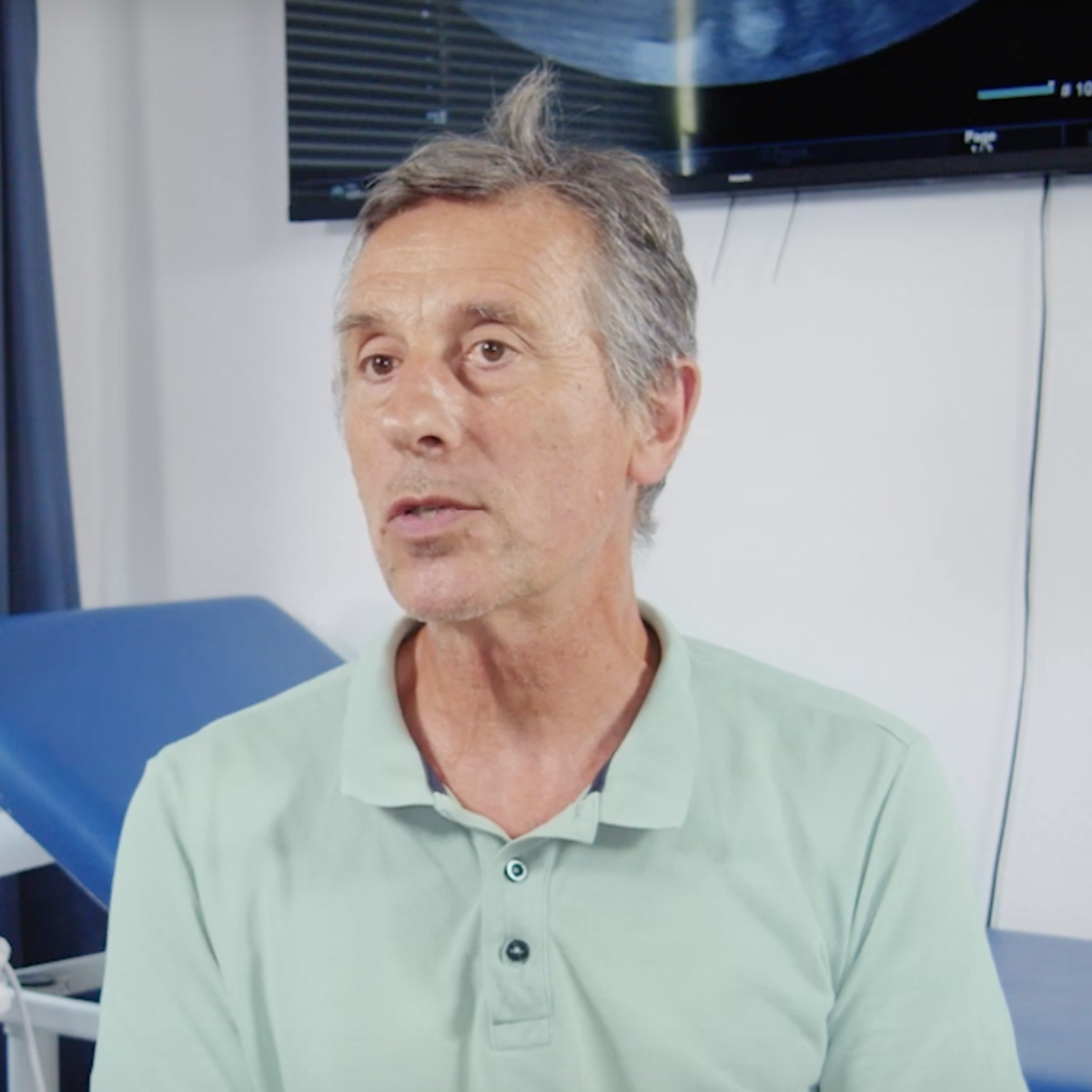
Dr. Guillaume Noge, a general practitioner in Charente-Maritime, uses the echOpen probe echOpen his practice to supplement certain clinical examinations—particularly when a patient returns for the same reason, when the examination raises concerns, or when he needs to determine the appropriate course of treatment more quickly.
His testimony is rooted in the reality of his practice. He describes the echOpen probe echOpen a troubleshooting tool that can be quickly deployed; he uses it in specific clinical situations, and it provides him with useful information on a daily basis.
Integrated use in clinical examination
For Dr. Noge, the echOpen probe echOpen the clinical examination whenever a situation calls for additional information. The procedure is performed seamlessly as part of the consultation and is reserved for instances where it provides genuine diagnostic value.
Three situations typically arise in his practice: a patient returning for a second visit for the same reason, a clinical examination that raises a suspicion, or simply the desire to confirm that nothing significant was overlooked in the initial evaluation.
"I often bring it up as a backup plan to see if I missed anything."
For example, when examining the inferior vena cava in patients with heart failure, he believes that ultrasound quickly provides him with a more accurate assessment of the situation, which can guide his treatment decisions immediately following the consultation.
Why Dr. Noge Purchased a Portable Ultrasound Machine
When discussing his decision to acquire the equipment, Dr. Guillaume Noge highlights two complementary motivations. The first is patient-centered: to better understand their conditions, advance his clinical reasoning, and avoid having to wait several months for an imaging appointment.
The second factor relates to the regional context. In Charente-Maritime, access to imagery can be difficult.
"Getting images is really time-consuming and complicated."
In this context, the echOpen probe echOpen more quickly identify which patients require imaging and which ones can be reassured based on a thorough clinical examination alone. It helps him better triage cases that require specialized imaging.
Lungs, bladder, inferior vena cava: practical applications
In his experience, certain applications are particularly well-suited to the echOpen probe. The lungs stand out as one of the most promising areas.
"It's great for your lungs."
He also mentions the bladder, which he says he can see very clearly, as well as the heart, although he notes that image quality depends on the patient and the conditions of the exam. The inferior vena cava rounds out this list of applications wherethe echOpen portable ultrasound device offers the most immediate benefit.
These uses are consistent with the approach of general practice: obtaining additional information quickly, without presenting the exam as a specialized ultrasound.
Like any ultra-portable device, the echOpen ultrasound scanner also echOpen to carefully identify the clinical questions it can address. Dr. Noge has tested it on a few more challenging applications, such as certain vascular evaluations or certain abdominal structures, for which he prefers to refer patients to specialized imaging.
"The better we know each other, the easier it is to get a good picture."
This point is key: quality depends not only on the camera, but also on the operator’s experience and ability to find the right shot.
Learning Ultrasound Through Hands-On Practice
Dr. Noge had already been exposed to ultrasound while working in the emergency room, where a portable ultrasound machine was available. He does not yet have a university degree in ultrasound, although he mentions this as a possibility for the future.
His training is primarily based on hands-on experience. His advice to new general practitioners is clear: to improve, you shouldn’t limit your learning to a private practice. To see pathological findings, he believes it’s helpful to gain experience in settings where clinical situations are more acute: emergency rooms, hospital wards, and with more severely ill patients.
In his view, this exposure to more severe cases remains a valuable complement to private practice, helping physicians develop their clinical eye, recognize pathological images, and gain confidence. This is also what makes access to clinical ultrasound training materials particularly important for long-term professional growth.
Features That Are Useful in Everyday Life
During the interview, Dr. Guillaume Noge discusses the addition of distance measurement to the echOpen app. This is a feature he had been looking forward to, particularly for estimating the inferior vena cava.
"These new features are awesome."
He particularly appreciates the fact that the zoomed-in area is shifted so as not to obscure the image during the estimation. He also appreciates that the distance segments can remain visible on the recorded images, which meets a need for traceability.
"Honestly, it's perfect."
Dr. Noge also mentions the value of being able to share an image with a patient or a colleague, for example, when he is unsure whether to refer a patient to the emergency room or when an image can help explain the situation.
"That's more than enough for the emergency room doctor or whoever to view the image."
What this feedback shows
When asked whether the echOpen probe echOpen the need for which he purchased it, his response is very clear.
"In 80% of cases, it works well."
This sentence accurately reflects his entire testimony. The echOpen portable ultrasound device echOpen used as a troubleshooting tool in specific situations, providing useful additional information in most cases where he chooses to use it.
Dr. Noge’s testimony thus illustrates the practical role the echOpen probe can play echOpen a general practice setting: a portable, readily deployable tool that enhances the clinical examination and helps guide certain treatment approaches more effectively.


.png)
.png)