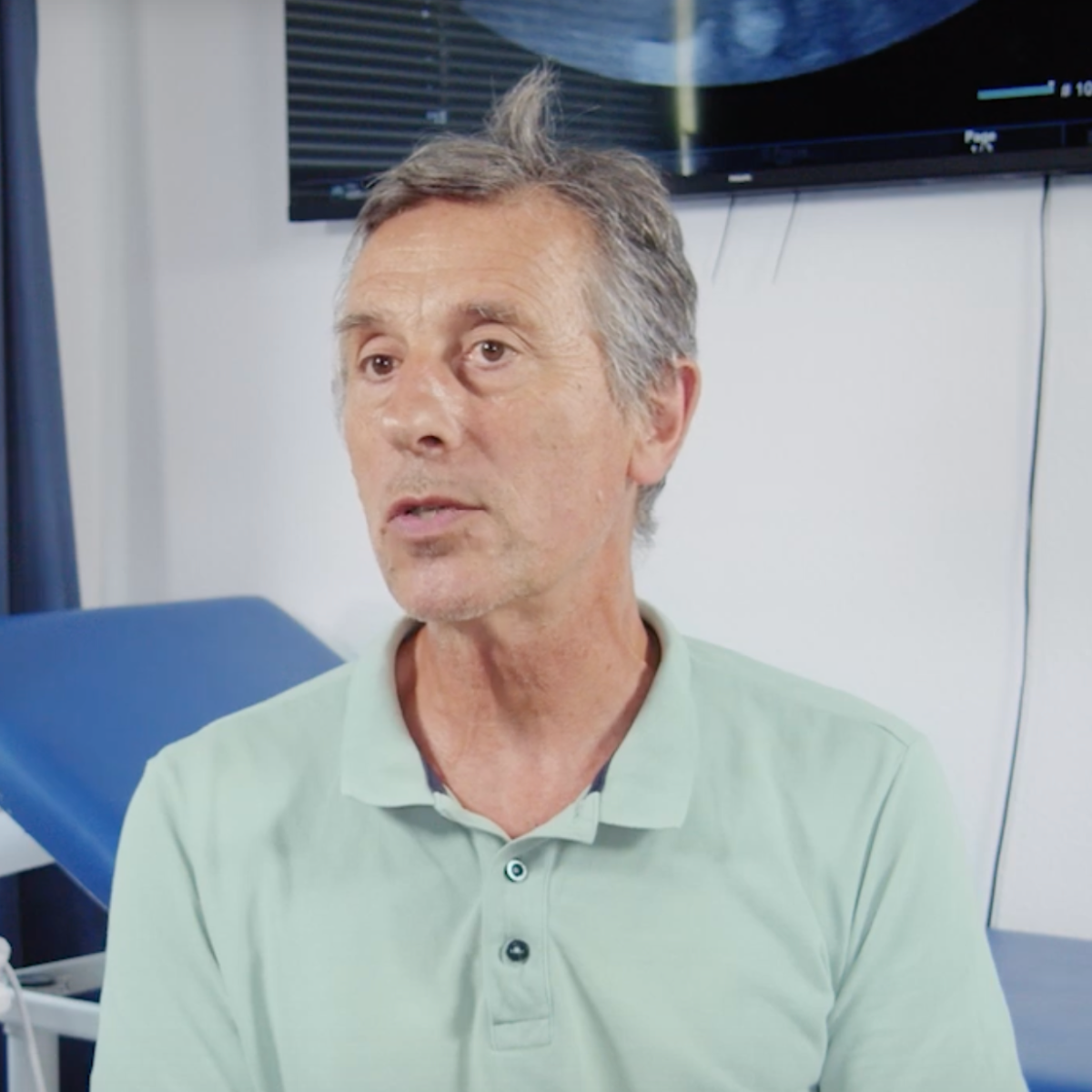
Ultrasound at the office of Dr. Wissam Elassad, a general practitioner
"I can get the answer right away at the office."
Dr. Wissam Elassad, general practitioner
As a general practitioner, Dr. Wissam Elassad uses the echOpen probe about two to three times a week. Whether it’s localized abdominal pain, checking for a urinary obstruction, or assessing residual urine after urination, he relies on ultrasound to help clarify certain clinical issues during patient visits.
Discover a tool you're already familiar with at the office
The doctor received training in ultrasound as part of his emergency medicine training, using portable ultrasound machines. His experience in the emergency room made him want to have this tool available in his office as well, in case a question arises during an exam.
He mentions the wait times involved in getting an ultrasound appointment in town. For certain situations that he believes he can evaluate himself, having an ultrasound probe allows him to get an answer right there in the office, the moment he sees the patient. As he puts it: “I can get the answer right away in the office.”
The cost of the equipment also played a role in his decision. He had considered another device, which he estimates cost around 20,000 euros: “For two to three times a week, it’s not cost-effective.” The more affordable price of the echOpen probe was therefore a key factor in his decision to purchase it. “And it’s cheaper than the others, too,” he adds.
Investigating a Specific Abdominal or Urinary Issue
He explains that he uses the probe both to investigate a clinical issue and to support a hypothesis. In his practice, he uses it primarily to examine the abdomen and the urinary tract. He describes procedures to check for urinary obstructions and to assess residual urine after urination. “I’m looking for a urinary tract obstruction,” he explains. He distinguishes these specific situations from vague abdominal pain, which he considers more complex and may require a CT scan.
A recent case illustrates this use: when faced with kidney failure, he used the probe to check for a possible urinary obstruction. Regarding this specific situation, he explains: “I get the results right away. I don’t need to send the patient to the emergency room for a CT scan.” What he emphasizes in this case is the ability to assess the issue directly in his office.
A probe that is easy to use during a patient visit
Dr. Elassad uses the probe on his smartphone. In his practice, he appreciates how easy it is to use: “It’s convenient, easy to use, and fast, too.”
This speed is particularly evident in the connection between the sensor and his phone, a step he describes as quick before he can start using it: “It doesn’t even take a minute—it’s already connected.”